The Assimilation Threshold
Why Good Intentions Fail at Scale

There is an old saying in Michigan that everyone on the West side of the state thinks everything East of Lansing is Detroit, and that everyone in Detroit thinks everything West of Lansing is Indiana. The Upper Peninsula wants to be its own state, and the Thumb wants to be its own country.
Those of us in the Lower Peninsula call the people in the Upper Peninsula ‘Yoopers,’ and the people in the Upper Peninsula call those of us who live in the Lower Peninsula ‘Trolls’ after the troll who lived under the bridge in the children’s story The Billy Goat’s Gruff.
Outside of tourism, there are not many jobs in the Upper Peninsula, although it is absolutely gorgeous up there, and the Mackinac Bridge, at five miles long, is one of the most underappreciated bridges in the world.
The last time I was in the Upper Peninsula, a Yooper told me they call those who live under the bridge Trolls. I said, “You Yoopers have another nickname for those from the Lower Peninsula.” He asked what it was and I said, “Employed.”
I was born and raised in Kalamazoo, which is on the West side of Michigan, and though I have lived in the Detroit area for about 20 years, I’ll always be a bit of a transplant.
My wife was born and raised in communist Poland, but she has lived in the Detroit area for more than 30 years and knows it better than I do. She originally immigrated to Hamtramck, and eventually moved to one of the nicer suburbs.
My wife spent a lot of money immigrating to the United States. She came over on a student visa and applied to extend it. Eventually she got a green card, and after we married she became a citizen. After fees and everything, citizenship cost her about $10,000 twenty years ago. In today’s money, that’s about $16,000.
My wife, as a legal immigrant, has to pay taxes to cover the living expenses, college costs, and medical care of those who immigrated illegally. That’s in addition to having to pay her own living expenses, college costs, and medical care costs.
If you immigrate illegally, your living expenses, college expenses, and medical expenses are paid for by others, whereas if you do everything legally, you are taxed to pay for those who broke the law.
I wrote about how Social Security forced us to allow illegal immigration several months ago. Suffice it to say, the system was designed for an ever-growing population, and in order to keep it solvent as our birth rates dropped and as people lived longer, we had to import workers to keep the system solvent. During the illegal immigration peak under Joe Biden, the United States taxpayer was paying $195 billion a year, through USAID into various NGOs, to illegally migrate people through South and Central America, into the United States.
That is in addition to the costs of supporting illegal immigrants once they got here.
The European nations call their various versions of Social Security by the correct name: “Pension,” but their systems are designed the same way ours is, where those currently working pay special taxes to cover the obligations to those who have retired. The economic need to pay those pensions with a shrinking workforce and an aging population is one of the reasons Europe (with our help) destabilized the Middle East, to create a massive migration of people from the Islamic world into Europe.
Modern immigration debates almost always begin from a false premise. Immigration is treated as a moral binary in which one is either “pro-immigration” or “anti-immigration,” “compassionate” or “cruel,” or some other such thing. This framing is emotionally satisfying but intellectually useless.
The question is whether or not we can assimilate immigrants at the pace needed to save our insolvent retirement system.
Assimilation is a rate-dependent system, subject to limits in the same way any complex social system is. The moral quality of immigration policy cannot be assessed without reference to the absorptive capacity of the nation being immigrated into. Ignoring the immigration capacity guarantees failure, causing disaster for both the immigrants as well as for the native population.
Assimilation is routinely misunderstood. It is not automatic and does not occur simply because newcomers arrive in a free society. Assimilation is a finite social capacity, dependent on institutions, expectations, incentives, and most importantly, the confidence of the host culture in its own norms. Like any capacity, it can be exceeded.
The critical variable is pace relative to assimilation capacity. Below a certain threshold, assimilation proceeds. Above it, the process breaks down.
This is not a moral judgment, but a structural reality. Societies can ignore these consequences, but we need only to look to Europe to see the costs of doing so.
When immigration exceeds a society’s assimilation threshold, the character of the society changes. Responsibility shifts away from individuals and communities and toward institutions. Informal norms give way to formal rules, and judgment is replaced by procedure. Over time, administration expands in an attempt to manage what culture no longer can.
If that administrative layer fails, as it inevitably does under sustained pressure, the only remaining tool is coercion.
This is the trajectory modern societies enter, not because they are hateful, but because they refuse to think in systems rather than slogans.
The Assimilation Threshold
The most persistent mistake in immigration debates is the belief that good intentions override scale. They do not. Intentions may matter from a purely moral perspective, but they matter very little systemically. Systems respond to pressure - not sentiment.
There is also a difference between something feeling good, and something doing good. Many things that may feel good to the uniformed, can actually do a great deal of harm if implemented. Conversely, some of the things that do a great deal of good may feel counterintuitive to the uninformed.
Good intentions often exist at the level of feeling good, which is why we have the saying, “The path to Hell is paved with good intentions.”
There are also short term, first level effects from any given policy, as well as longer term, second, third, or higher level effects. Often the short term effects of a given policy are the opposite of the long term effects.
It is entirely understandable when individuals who may not know a great deal about a particular topic vote based on what feels good, or vote only based on short term effects. It is however incumbent upon those in elected office, or in unelected government positions, to go beyond feeling good and inform themselves on what actually does good in the long term.
At a minimum, assimilation requires several non-negotiables. The first is that the immigrant must subordinate their own moral framework to that of the host society, at least in the public sphere. This does not mean abandoning private belief or cultural memory, but it does mean accepting that the host nation’s norms govern public life. Without this moral subordination, assimilation cannot begin.
Language acquisition is equally essential. A shared language is not just a tool for communication, but is the mechanism by which cultural norms and expectations are transmitted. Trust depends on being understood, so societies that fracture linguistically fracture socially as well.
Finally, assimilation requires institutional trust. Immigrants must view the host society’s legal, political, and civic institutions as legitimate, even when those institutions act against their immediate interests. If courts, police, schools, and laws are regarded as alien or hostile, parallel systems inevitably emerge.
The assimilation threshold, the point at which absorption gives way to fragmentation, varies significantly based on several factors.
Cultural distance matters. Immigrants from societies with similar social norms, expectations of civic behavior, and conceptions of individual responsibility assimilate more easily and more quickly than those from societies organized around fundamentally different assumptions.
Moral compatibility matters even more. Differences in cuisine, clothing, and custom are trivial compared to differences in how authority, law, individual rights, and moral obligation are understood. Where moral frameworks align, assimilation is smooth. Where they conflict, assimilation becomes difficult at best.
The confidence of the host culture may be the most decisive factor, as a society that asserts its norms unapologetically, and that expects newcomers to conform to them, can absorb far more difference than a society plagued by self-doubt.
Moral confidence raises the assimilation threshold. Moral uncertainty lowers it.
Finally, expectations matter. A culture that expects assimilation will generally get it. A culture that insists on neutrality, treating all norms as morally equivalent; or that fears asserting its own standards upon newcomers, isn’t really looking for assimilation, and what is no longer expected eventually ceases to occur.
The key insight is this: weak moral confidence dramatically lowers the assimilation threshold, and even modest immigration levels can overwhelm a society that no longer believes it has the right to shape those who enter it.
When that threshold is crossed, the problem is not solved by compassion or good intentions. Instead, the society begins to balkanize around different moral norms until the only way to keep the society from tearing itself apart is through totalitarianism.
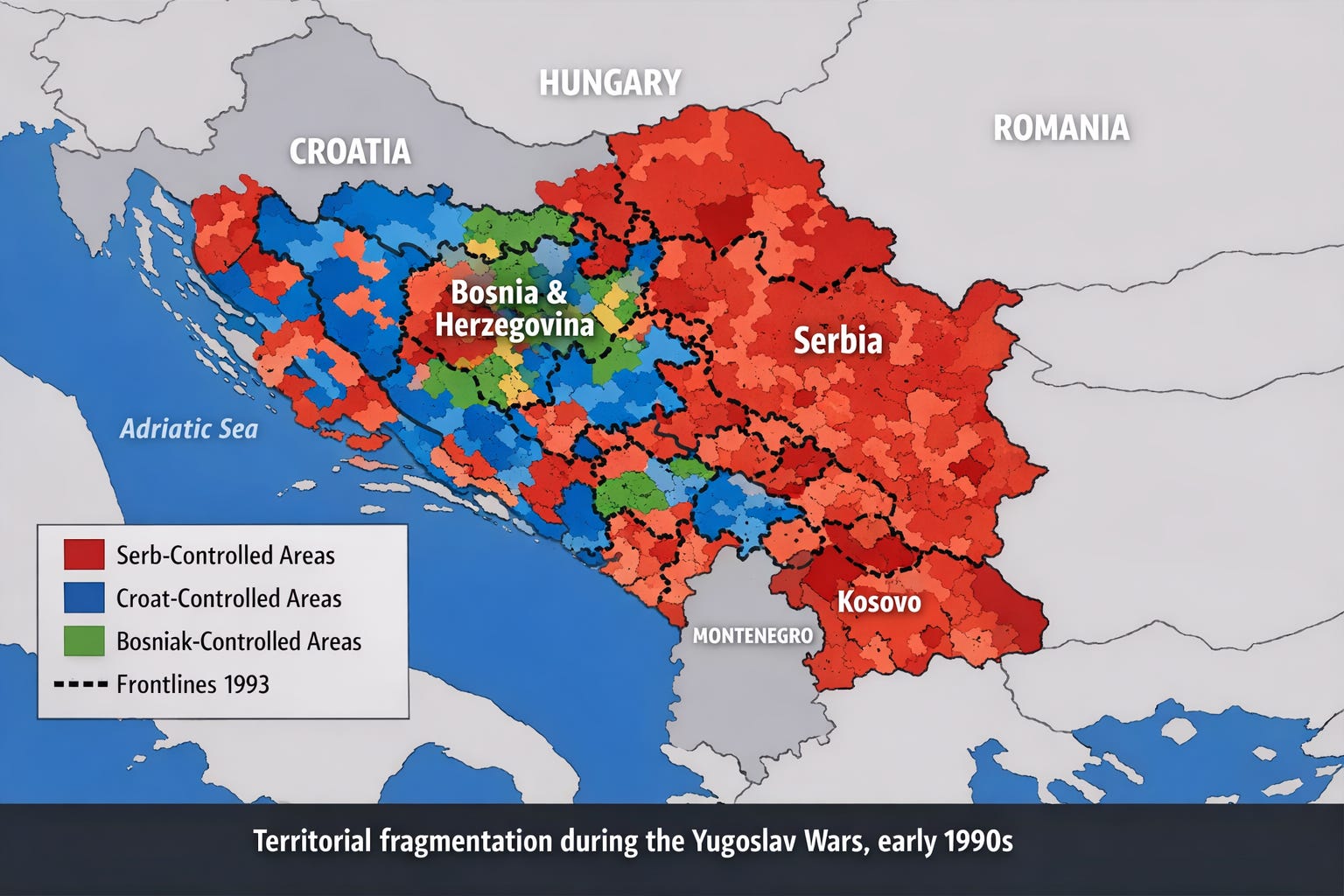
Yugoslavia is a case study in totalitarianism and balkanization. Tito kept the country together only through totalitarian force, and when he died Yugoslavia split into regions that almost immediately went to war, most notably with Serbia invading and trying to ethnically cleanse Bosnia.
Yugoslavia started with different moral orders, with Eastern Orthodox as the primary religion in the Serbian region, Roman Catholicism in the Croatian region, Islam in Bosnia, and secularism in Slovenia. The greatest conflict came between the Eastern Orthodox and Islamic regions.
Liberal Democracy’s Moral Foundation
One of the most damaging myths in modern political thought is the belief that liberal democracy emerged from moral neutrality. It did not. Neutrality was not the starting condition. It was, at best, a downstream luxury.
Every functioning liberal democracy in modern history emerged from a Christian moral substrate. This is not a theological claim, but an historical one.
Long before constitutions, courts, and parliaments existed, Christian moral assumptions had already shaped how law and responsibility were understood in the societies that later became liberal democracies. The core assumptions that make liberal democracy possible were inherited from Christian ethics and then translated into civic form.
The idea of individual dignity is not self-evident. It rests on the belief that each person possesses intrinsic worth by virtue of being human. That belief did not originate in Enlightenment philosophy. It came from Christianity’s assertion that every person is made in the image of God.
Equality before the law likewise did not emerge from civil discourse. Historically, law reflected caste. Christianity undermined caste by insisting on moral equality before a higher authority that supplanted social hierarchies. Liberal democracies later secularized that moral claim into legal equality.
Finally, liberal democracy depends on the elevation of conscience over coercion. Christianity, uniquely among world religions at the time, renounced forced belief on the assumption that force led to corruption. That theological principle later became the foundation for freedoms of speech and religion.
Coerced belief is by definition not free.
The Enlightenment did not replace Christian morality. It secularized it, stripping away theology while retaining the moral architecture Christianity built. The institutions remained functional only so long as the underlying moral assumptions remained widely shared.
This brings us to what is often cited as an exception: Israel
The Laws of Moses can be broken up into civil law (for the governing of the ancient state of Israel), ceremonial law (separating God’s Chosen People from the other peoples of the Earth), and moral law.
Israel stands as the one modern liberal democracy that did not arise from a Christian culture, yet it functions for the same reason Western liberal democracies historically did: Judaism shares the same moral law.
Judaism and Christianity are morally identical. They agree on the nature of human dignity, the objectivity of moral law, the limits on power, and the illegitimacy of coercive belief. Christianity did not invent a new moral framework; it universalized the Jewish one. Nobody argues that Judaism and Christianity are the same religion, but Christianity was borne out of Judaism, and theological scholars to this day point out that what these religions share in many ways makes them act functionally almost more like separate sects of the same religion, rather than separate religions.
They are not sects as they have fundamentally different beliefs on the nature of the Messiah, and thus the nature of Man’s relationship with God, but the moral foundations are shared.
Because of this shared moral foundation, liberal institutions can function in Israel in ways they cannot where the moral law is contested or subordinate to political or religious authority.
This point matters. Liberal democracy is not merely a set of procedures. It is a moral system that presupposes shared limits.
Courts only function if their authority is recognized as legitimate. Rights only exist if restraint is viewed as virtuous.
Liberal institutions cannot float freely above culture. They are anchored to it. When the culture that sustains them erodes, neutrality does not save them. Administration replaces norms, coercion replaces consent, and the system survives only by force.
Liberal democracy did not begin neutral, and it cannot remain stable once neutrality is elevated above moral inheritance.
That fact explains both its historical success and its present fragility.
Moral Compatibility, Not Mere Tolerance
Modern immigration debates lean heavily on the language of tolerance. The assumption is that if a society is sufficiently open-minded, culturally diverse populations will coexist peacefully and, over time naturally converge. This assumption rests on a fundamental error by treating all differences as equivalent.
They are not.
Some differences are trivial from the standpoint of social cohesion. Differences in food, dress, music, accent, and custom pose no threat to a liberal society. They are cosmetic variations that sit comfortably atop a shared civic framework. Even linguistic differences, while significant, are manageable so long as language acquisition proceeds and a shared public language eventually emerges. These are the differences most people have in mind when they speak about diversity.
But these are not the differences that determine whether a society holds together.
What matters is moral compatibility.
A liberal democracy can tolerate an enormous range of cultural expression, but it cannot function if multiple, competing claims to ultimate moral authority coexist within the same legal and civic space.
Assimilation does not require immigrants to abandon private religious faith. It does, however, require acceptance of the host society’s ultimate authority in the public sphere. At a minimum, assimilation requires acceptance of the supremacy of civil law over religious or customary law. It requires acceptance of free speech, including speech that offends or blasphemes. It requires acceptance of freedom of religion, which necessarily includes the freedom to leave one’s religion.
These are not optional features of liberal democracy. They are foundational, defining the moral boundaries within which pluralism is possible. Any system of belief that rejects these commitments cannot coexist as an equal authority without undermining society at-large.
This leads to a simple but uncomfortable reality: any moral system that claims total jurisdiction over human life must either dissolve, or fail to assimilate, as there is no stable equilibrium in which two sovereign moral authorities peacefully share the same civic space, outside of totalitarianism.
At small numbers, assimilation is the dominant force. Social pressure flows in one direction, from the host culture toward the immigrant. Incentives reward conformity, and nonconformity carries cost.
Daily life immerses newcomers in the expectations and informal rules of the surrounding society. Over time, incompatible beliefs weaken. Intermarriage encourages this, with children absorbing the moral assumptions of their peers more readily than those of distant ancestors.
This is how assimilation has historically worked, but when the numbers of immigrants are too high, the dynamics invert.
As population size increases, immigrants no longer experience the host culture as a surrounding force. Instead, they experience it as one environment among many. Internal institutions emerge: religious authorities, schools, media outlets, advocacy organizations, and informal enforcement mechanisms. What was once cultural memory becomes cultural infrastructure.
At this point, ideology no longer weakens across generations. It self-reinforces. Children are socialized internally before they ever meaningfully encounter the broader society. Norms are taught intentionally rather than absorbed, and deviations are corrected by the immigrant community to prevent assimilation.
Most importantly, internal dissent becomes costly. The pressure to conform no longer comes from the outside. It comes from within, making assimilation an act of defection.
Scale is the pivot point. It determines whether exposure dissolves ideology, or concentration preserves it.
The diagnostic analogy is straightforward. If ten committed ideological extremists are placed into a liberal society, their ideology will dissolve over subsequent generations as social pressure overwhelms their children. Their grandchildren will in most cases barely even remember the original belief system, no matter how extreme.
If ten million are introduced at once and then concentrated geographically, the opposite occurs. They establish institutions, transmit doctrine intentionally, and work to preserve and extend their worldview.
The same thing occurs across the United States, from Little Cuba in Miami to Little China in San Francisco. The difference is that Little Cuba and Little China differ only culturally from the rest of the United States, attracting visitors who want to experience those separate cultures. These people assimilate into American civil society, and the differences are actually healthy. Who, after all, can turn down a good Cuban sandwich, or an authentic bowl of Hot and Sour Soup?
Some immigrant groups, however, differ morally, and that is where problems emerge.
This is not a failure of tolerance, either. It is a failure of category distinction.
Tolerance is appropriate for cultural variation, but insufficient for competing claims of moral sovereignty. A society that refuses to distinguish between negotiable cultural difference and non-negotiable moral authority mistakes openness for stability. In doing so, it ensures that assimilation becomes structurally impossible.
When that point is reached, conflict is no longer a matter of prejudice or misunderstanding. It is the inevitable consequence of allowing scale to convert difference into permanence, and tolerance into abdication.
A liberal society that cannot make this distinction does not remain liberal indefinitely. It becomes administrative, then coercive, as no other tools remain once assimilation fails.
Hamtramck: A Living Case Study
Shortly after I met my wife, she told me she had to go to Hamtramck. Gosia had lived in Hamtramck for years before moving into the suburbs. Her brother, at the time, still lived there.
Having grown up on the West side of Michigan, my mind made no differentiation between Detroit proper and its many suburbs, and I had never heard of Hamtramck, but the name has a kind of phonetically New England vibe to it, so I thought it was in Connecticut.
Gosia asked me if I wanted to go with her. I told her I couldn’t take the time off of work to go to Connecticut. Gosia had no idea what I was talking about - Hamtramck is one of two ‘suburbs’ that are completely surrounded by Detroit, and as we talked, I was shocked to find out that Hamtramck was only about 20 miles away.
Connecticut is a lot further away.
For more than a century, Hamtramck functioned as an entry enclave. New immigrant groups settled there because it was affordable, and close to industrial work. Hamtramck was never the destination though. It was simply the first rung on the ladder.
Germans, Poles, and other European immigrants passed through Hamtramck in successive waves. They clustered initially out of necessity, relying on shared language and community support while they established themselves economically, but as upward mobility came, movement followed.
The direction of that movement matters. It was upward and outward.
As Polish immigrants, their children, and their grandchildren accumulated wealth, they dispersed into surrounding suburbs such as Birmingham, Troy, and Rochester Hills. Ethnic identity softened into heritage. Language was often retained for a generation, but usually not two.
What matters here is that this pattern repeated reliably across immigrant groups for generations. Hamtramck worked as a temporary incubator, not a permanent cultural island.
That pattern has changed.
More recent immigration into Hamtramck does not show the same outward diffusion. Instead of upward mobility leading to dispersion into the surrounding region, growth increasingly takes the form of lateral, contiguous expansion. Population increase spills outward while remaining geographically and culturally connected to the original enclave. The community grows, but it does not dissolve. Hamtramck and Dearborn are both today parts of the same Islamic enclave.
This distinction is critical. Lateral expansion preserves internal authority structures. Cultural norms are reinforced rather than diluted, and exposure to the host culture is reduced. As population density rises, rather than serving as a bridge into American society, the enclave becomes self-sustaining.
As a result, cultural authority remains internal. Norms are taught, enforced, and reproduced within the community, and the expectation that public behavior conforms to American standards dissolves. Assimilation, once the default outcome, becomes optional, and eventually unnecessary.
Hamtramck, then, illustrates the difference between entry enclaves and permanent enclaves. The former dissolve through success. The latter persist through scale. One leads to convergence whereas the other leads to parallelism.
I mentioned that Hamtramck and Dearborn are, today, primarily Islamic. That’s important. As I’ve written in White Rose Magazine, the morality of Islam is largely an inversion of our own. The two are not compatible.
That’s not to say Muslims are not compatible with our society, but it is to say that fundamentalists within Islam are not, and that the more devout toward Islam one gets, the less compatible with Western civilization they become.
This is not a judgment about the character or intentions of the people involved. It is an observation about systems. When immigration remains below the assimilation threshold, enclaves function as gateways. When that threshold is exceeded, enclaves cease to be transitional and instead become destinations. At that point, assimilation does not merely slow. It changes direction.
Hamtramck matters because it shows this shift in real time, at the neighborhood level, where abstractions give way to lived reality.
I pick on Hamtramck because it is close to home, but similar patterns of both assimilation, and its opposite, occur all across the United States.
From Failed Assimilation to Administrative Control
When assimilation fails, societies do not collapse immediately. They attempt to compensate, and the first response of a fragmented society is administration.
As moral consensus erodes, the informal systems that once governed daily life lose their authority. Norms no longer bind because they are no longer shared. What was once enforced socially must now be enforced procedurally.
Norms are replaced by rules.
Where behavior was once shaped by expectation and shame, it is now shaped by policy and compliance. Where communities once mediated conflict directly, institutions step in to referee. The role of government expands not because it seeks power, but because something must manage the differences between moral systems after culture no longer can.
This is the phase often described as “multiculturalism,” but it is more accurately understood as administrative multiculturalism. Diversity is no longer sustained through shared moral limits, but through regulation. Disagreement is not resolved so much as it is suppressed.
This arrangement can persist for a time. In fact, it can feel deceptively stable. Procedures give the impression of fairness.
But this stability is fragile.
As parallel communities solidify, administrative systems are increasingly asked to perform moral arbitration without moral authority. Every rule begins to look partisan. Every enforcement decision is interpreted as favoring one group over another, and this is particularly true once different rules emerge for different groups and the law is selectively enforced.
At this stage, parallel identities harden. People no longer see themselves primarily as participants in a shared civic order, but as members of competing groups within it. Law is no longer perceived as impartial. It is viewed as a weapon or a shield, depending on who wields it.
As trust collapses, politics transforms. It ceases to be a debate about policy and becomes demographic warfare. Votes are counted less as expressions of preference and more as expressions of group power.
This is the point at which administration begins to fail.
Rules can manage differences only so long as all parties accept the authority of the rulemaker. When that authority is no longer recognized as legitimate, enforcement becomes a source of conflict. The state is no longer an umpire. It is a participant.
At this stage, only two outcomes remain.
The first is coercive unity. The state asserts control through surveillance, speech restrictions, politicized law enforcement, and the suppression of dissent. Order is preserved, but only by force. This is not harmony. It is containment.
The second is fragmentation. The shared civic space dissolves. Communities separate formally or informally. Borders harden, whether on maps or in practice. The state shrinks, splits, or disappears.
What does not survive this phase is liberal neutrality. A society cannot simultaneously lack a shared moral foundation and refuse coercion. One must give way to the other.
This is why failed assimilation does not lead to a gentler, more pluralistic society. It leads to a more regulated one, then a more coercive one, and finally, if force cannot hold, a divided one.
Administration is not the opposite of balkanization. It is the last attempt to prevent it.
And when administration fails, what remains is power, exercised openly, or fragmentation, embraced reluctantly.
There is no third path.
What Nations Must Choose
The old Michigan jokes at the beginning of this essay work because they are harmless: west versus east, Yoopers versus Trolls - friendly rivalries, mild resentments, and exaggerated differences that everyone jokes about.
These differences exist inside a shared culture. No one seriously believes Michigan will split into warring states because the Upper Peninsula feels neglected or because Detroit thinks everything west of Lansing is Indiana.
Those divisions matter only because they don’t matter.
That is the distinction this essay is about.
Nations do not face a thousand choices at once. They face a narrowing sequence of them.
First comes the choice between assimilation and administration. A society can expect newcomers to adopt its norms and moral limits, or it can attempt to manage differences indefinitely through policy, regulation, and procedure.
Assimilation requires confidence and clarity. Administration requires neither, but it comes at a cost.
When administration expands far enough, the next choice appears: administration or coercion. Rules only work while they are viewed as legitimate. Once they are seen as partisan or imposed, enforcement becomes necessary. Surveillance grows. Speech narrows. Dissent is reframed as destabilization. The society remains intact, but only because force replaces consent.
And when coercion can no longer hold, the final choice emerges: tyranny or fracture. At that point, unity survives only as containment. Remove the pressure, and the system breaks apart along the moral and cultural seams immigration without assimilation created.
These are not ideological predictions. They are historical patterns.
None of this happens because people are hateful. It happens because societies mistake tolerance for cohesion, neutrality for strength, and good intentions for structural wisdom. People forget that liberal democracy was never morally neutral, and that it cannot survive without defending the moral foundations that made it possible in the first place.
My wife did not move from communist Poland to Hamtramck because she wanted to live inside an enclave. She moved there because it was an entry point. She left because assimilation worked, rewarding participation in a shared civic culture rather than permanent separation from it, and by the time I met her, she had a condo in one of the nicest communities in the country.
That path remains possible. But it is not automatic.
A society unwilling to defend its moral foundations will not remain free. It will become managed, then coerced, and finally divided.
The question nations face is not whether they wish to be compassionate, tolerant, or diverse. The question is whether they believe in themselves strongly enough to remain whole.
Everything else follows.
Great essay, Wallace! It is very illuminating on how assimilation works to sustain a common culture and how “multiculturalism” can undermine it. All cultures are not the same and achieving a common culture in a large, diverse country is not easy, especially if rapid immigration of people with divergent cultures are unable or unwilling to assimilate into key norms of the host country. Unfettered immigration (especially if its illegal) can look more like an invasion to many citizens of the host country if its not effectively controlled and if much of the host country has lost sufficient faith in the validity if its own key shared values. This is where neutrality and tolerance is problematic and even dangerous to national survival.
I love reading your essays. They are written with such clarity. I just finished reading for the 2nd time “Dominion” by Tom Holland and I think this essay succinctly ties into his read of history also, we are standing within the air that Christianity/Judaism breathed into our world. I pray we are able to stand up and defend with moral clarity our culture. Well done, once again Wallace.